
Inmotion P6 vs Begode X-Max vs Veteran Sherman-P
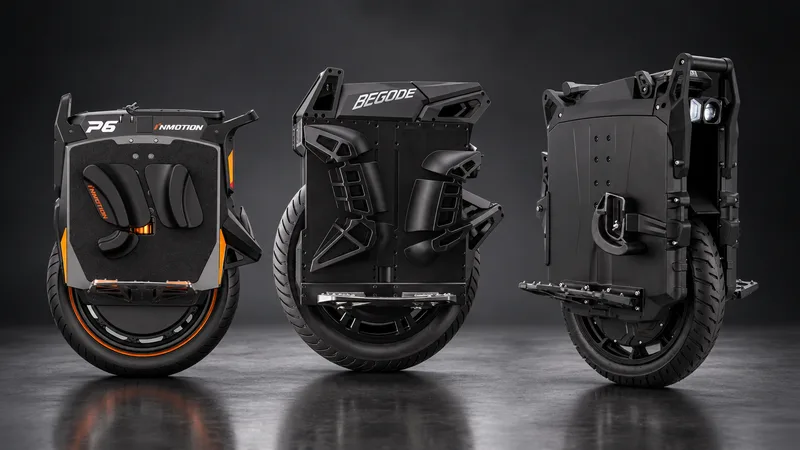
You buy a wheel for the whole session: the ride out, your favorite section and the return when the battery is lower and your legs are tired. What matters is the pace you want to hold, the reserve left at the end and whether next weekend will be spent riding or waiting for a part.
Three flagships, almost the same weight, three different answers to those needs. The Inmotion P6 puts its case on electronics and speed. The Begode X-Max combines the highest maximum voltage here with the longest claimed suspension travel. The Veteran Sherman-P gives the biggest battery to the rider who wants to stay out longer.
This is a buying and engineering comparison, not a riding review. We have no matched road tests, thermal logs or braking measurements for these three wheels. The recommendations below concern the hardware proposition and the evidence behind it.


Product imagery of the individual models, shown at different scales.
New flagships, different time on the market
This EUC segment still calls for an early-adopter mindset: buying the hardware means accepting some of the uncertainty of a new platform. EUCs themselves are no longer a novelty, but extreme flagships at these voltages, speeds and weights are still building their ownership history. In this comparison, a platform’s age matters as practically as another specification.
- P6: INMOTION was describing it by September 11, 2025, with its official launch announcement published on October 17, 2025. As of September 23, 2026, that means about a year since public presentation, not a confirmed year of regular customer deliveries
- X-Max: In its July 3, 2026 announcement, Begode scheduled mass production for late July. September preorders do not establish when the line actually started or when the first batch reached customers
- Sherman-P: September 2026 brings listings and rideable demo units; Next Gen expects its first batch in October. It is too early for a production ownership history
P6 deserves credit here. Almost a year after its presentation, it remains a meaningful reference point for new speed-focused flagships: it has a 150 km/h (93 mph) riding-speed claim and a manufacturer-reported loaded track run. The newer X-Max raises voltage, but free-spin numbers alone do not establish that it has overtaken P6 on the road. That is a strong argument for INMOTION’s ambitious platform, though not proof of an outright market-wide record. A new launch does not automatically push last year’s wheel out of the top tier.
The short answer
- P6: For an experienced rider prioritizing a documented electrical platform and track-speed potential, accepting the smallest battery here and a 14 A charging ceiling
- X-Max: For a rider interested in mixed street and rough-surface use, willing to accept unresolved production details in exchange for 252 V and adjustable 100-130 mm travel
- Sherman-P: For a distance-focused rider drawn to 4700 Wh and two charging ports, willing to wait for production confirmation of the dealer specifications
- Wait: If this must be your dependable only wheel, or your purchase depends on proven range, low-battery performance or first-batch reliability
Your riding comes before the specifications
Our guiding rule is simple: choose for the whole session, with reserve at the end and ownership demands you can live with. Three questions help separate an actual need from the appeal of the biggest number:
- What does your session look like? Short track runs with cooling and charging breaks are a different job from hours on the road. On group rides, count the journeys to and from the meeting point too; your battery plan should not end where the shared route ends
- What do you carry, and where do you stop? Equipped rider weight, standing or seated posture, wind and climbs change consumption and drivetrain load. A large charger only helps if you have compatible power, time to stop and space to carry it
- How much downtime can you absorb? A second wheel in the garage and nearby service make a first batch a different ownership decision from relying on one wheel to get to work every day
Start with what limits your current wheel: battery capacity, temperatures, insufficient reserve at your pace, fatigue on rough surfaces or service. If you cannot identify that limit, a new flagship can still be a purchase for enjoyment - but a launch date alone is no reason to replace equipment that already works for you.
What the numbers actually mean
The comparison follows the current 555 model catalog. [M] means manufacturer documentation, [D] a dealer claim, and [E] a provisional editorial estimate. A specification confirmed in a manual is still not an independent performance measurement. All Sherman-P figures below remain dealer/pre-production data. Unknown means the evidence is missing, not that the feature is absent.
| Specification | Inmotion P6 | Begode X-Max | Veteran Sherman-P |
|---|---|---|---|
| Maximum voltage | 235.2 V [M] | 252 V [M] | 176.4 V [D] |
| Battery / cells | 4032 Wh rated [M]; Samsung 50S | 4400 Wh [M]; Samsung 50S | 4700 Wh [D]; Samsung 50S |
| Weight | 51 kg (112 lbs) [M] | 52 kg (115 lbs) [M] | 52 kg (115 lbs) [D] |
| Motor: rated / peak | 6000 / 20,000 W [M] | 6000 / 12,000 W [M] | 3800 / 10,000 W [D] |
| Catalog speed | 150 km/h (93 mph) [M] | 120 km/h (75 mph) [E] | 100 km/h (62 mph) [D] |
| Catalog range | Up to 150 km (93 mi) [M] | 100-180 km (62-112 mi) [E] | 100-200 km (62-124 mi) [D] |
| Suspension travel | 90 mm hydraulic [M] | 100-130 mm adjustable [M] | 90 mm hydraulic coil/oil [D] |
| Charge ports / stock charger | 1 / 5 A [M] | 1 / 5 A [D] | 2 / 5 A [D] |
| Maximum charge current | 14 A [M] | 20 A [D], not manufacturer-confirmed | 20 A combined [D] |
| Charge time at 5 A | About 4 h [M] | Unknown | About 6 h [D] |
| Body / battery IP | IP56 / IP67 [M] | Unknown; dealer says IP67 without a split | IPX6 / unknown [D] |
Speed and range rows are not a matched test or recommended riding limits. In particular, X-Max’s 120 km/h (75 mph) and 100-180 km (62-112 mi) are editorial catalog estimates, not Begode claims, measured results or numbers derived from free-spin.
Manufacturer specifications are available in the P6 manual and on Begode’s X-Max page.
What 51-52 kg buys you
At 51-52 kg (112-115 lbs), none of these wheels solves stairs, lifting into a car or retrieving a disabled wheel. That decision comes before voltage. Try the handles and trolley, check storage access, and budget for pads, protective parts and a charger you can actually carry. Published net weight is not the weight of your complete touring setup.
P6 allocates that mass to a high-voltage system and extensive battery electronics. X-Max combines a slightly larger battery with more suspension travel. Sherman-P has the largest advertised energy capacity. The numbers do not establish center of gravity, low-speed balance, shell toughness or ease of tire changes. Those need hands-on inspection.
All three use a 14-inch rim in the marketing “20-inch” class. X-Max can be ordered with a street or off-road tire from the outset - Begode itself offers that choice. Dealers identify the variants as 80/90-14 street and 2.75-14 off-road. P6 lists 80/90-14 in the catalog, while Sherman-P dealer listings offer street, hybrid and off-road tread choices. Choose for your routes when ordering, and confirm the exact tire, spring and pedal setup. A shared size label does not promise identical handling.
Voltage, controller and useful speed
Higher voltage gives the designer two useful tools. At the same electrical power, it reduces battery current: an illustrative 10 kW at 200 V requires 50 A; at 250 V, it requires 40 A. In a circuit section with unchanged resistance, that means 36% lower I²R losses. This illustrates the relationship, not a measurement of these wheels: changing the pack configuration changes its resistance, and battery current is not motor phase current.
The second benefit comes at speed. With the same motor, higher voltage provides more headroom above the voltage generated by the spinning motor, or back-EMF. It allows current control to continue to higher RPM and can delay the need for field weakening. For the rider, the useful part is reserve for acceleration and balance corrections while already moving quickly. P6, X-Max and Sherman-P have different windings and control systems, however; ranking voltage alone cannot rank torque or temperatures.
P6: INMOTION describes a Raptor S controller with 650 V SiC MOSFETs and vapor-chamber/fan cooling. SiC means silicon carbide: a transistor technology that can reduce switching losses in high-voltage systems. Its potential value to a rider is less heat to remove at high power. The actual benefit depends on the devices, gate drive and cooling of the complete board. The 6000 W rated and 20,000 W peak figures describe different operating conditions; the peak is not continuous output.
X-Max: Begode specifies 6000 W rated / 12,000 W peak and a tile-magnet motor. The term refers to magnets formed into arcs to follow the rotor’s circumference. That profile lets the designer shape the air gap and magnetic field facing the stator differently from flat segments. It can improve space utilization and torque characteristics, but the outcome depends on the complete motor geometry. Begode provides no comparable measurements of the gain here. Nor does this establish that every earlier EUC used flat magnets.
Begode specifies 42 MOSFETs in TOLL packages for the X-Max controller. TOLL means TO-Leadless: a compact surface-mount package with short connections and a large heat-transfer contact area. Its benefits include low parasitic resistance and inductance and the potential to remove heat effectively at high currents. TOLL describes the package; SiC describes the semiconductor material - they are not competing quality grades. P6 documentation establishes SiC but does not establish whether it uses TOLL. The guide to MOSFETs and controllers provides more context.
Sherman-P: Dealer material lists 3800 W / 10,000 W, 36 MOSFETs and a 960 A controller claim. That last number is not sufficiently defined as battery current, phase current or a usable continuous limit. Comparing transistor counts or peak labels cannot tell us which wheel accelerates harder.
P6’s 150 km/h (93 mph) is INMOTION’s claimed riding speed with a rider aboard. The manufacturer presents it as a test result, so it is more than a claim about a wheel spinning in the air. Its account of Apple Valley on October 12, 2025 reports Maxwell Berger reaching approximately 130 km/h (81 mph) on the straight. That is a specific loaded run reported by the manufacturer; it establishes neither P6’s absolute maximum nor a safe cruising speed at any battery level.
At 120 km/h (75 mph), air resistance is already a serious load on both rider and drivetrain. There is no magic threshold, though: in still air, with unchanged posture and aerodynamics, drag force grows approximately with speed squared and the power needed to overcome it with speed cubed. Going from 120 to 150 km/h (93 mph) means roughly 56% more drag force and 95% more aerodynamic power. This is a calculation, not a P6 measurement or a prediction of 95% higher total energy consumption. It explains why the last few kilometers per hour depend so heavily on rider posture, wind and available power.
X-Max’s published 154/208 km/h (96/129 mph) are explicitly free-spin values in off-road/race modes. Sherman-P’s roughly 170 km/h (106 mph) high-speed-mode figure is also unloaded. None of these free-spin numbers belongs in a riding-speed ranking.
Sherman-P stays at 100 km/h (62 mph) in our catalog, with its dealer/pre-production label intact. Dealer listings disagree, and Next Gen still marks its higher riding-speed claim as provisional. That is a reason to request production logs, not to replace the catalog figure with the largest advertisement.
For a purchase decision, ask what PWM, temperatures and safety margin look like as the battery empties. Field weakening extends the speed envelope but changes torque and thermal trade-offs. We do not have comparable production logs to turn any of these headline speeds into a reliable cruise recommendation.
Battery capacity is not touring range
P6 uses 4032 Wh rated energy in its manual. The product page still advertises 4200 Wh. We use the manual value and retain the conflict openly. Credit to INMOTION for publishing a specific rated-energy figure, but it is still not a measurement of energy available during a ride: that requires a defined load and discharge cutoff. Against 4032 Wh, X-Max’s advertised 4400 Wh is 368 Wh higher and Sherman-P’s 4700 Wh is 668 Wh higher. These are arithmetic differences between published capacities, not measured usable-energy advantages.
All three list Samsung 50S cells and Smart BMS. INMOTION describes distributed battery management through BMU, BCU and BDU modules. Sherman-P dealer material describes two 42S3P packs, 42S6P overall; X-Max’s exact pack topology is not established here. A common cell name or “Smart” label does not establish identical balancing, diagnostics or fault isolation.
P6’s catalog range follows the product page’s 150 km (93 mi), while the manual quotes 150-200 km (93-124 mi) under its stated test conditions. Neither is a fast-touring promise. X-Max’s range remains an editorial estimate; Sherman-P’s 100-200 km (62-124 mi) remains dealer/pre-production data. There is no controlled three-way range test behind these rows.
Speed, wind, rider mass, tire choice and voltage sag can erase an apparent advantage in Wh. Sherman-P is the strongest capacity-led candidate, but we cannot award it the longest real range. Plan around your own consumption and reserve; the range guide explains the variables.
Charging: amperes do not tell the whole story
P6 has one port and a 14 A maximum in the current manual. Its listed stock charger is 5 A, with an approximately four-hour charge claim. An older INMOTION launch article said 20 A; that does not override the current manual.
OneRide lists one port, a 5 A charger and up to 20 A for X-Max. The vehicle-side maximum still needs manufacturer confirmation. The optional PEVcharge charger’s advertised ability to supply 26 A is not permission to feed 26 A into the wheel. Begode explicitly requires respecting the wheel, BMS, wiring and connector limits.
Sherman-P dealers list two ports, 20 A combined and about six hours with the included 5 A charger. Those remain provisional, not a timed production test. Two ports do not mean 20 A per port. Other dealer material has quoted shorter charge times; the catalog retains about six hours pending a common test.
Even an approved 20 A does not give the same charging power on different voltage platforms. Taper near full charge, balancing, battery temperature, charger limits and the available AC supply also change stop length. We therefore make no 20-80% time prediction and no fastest-charging award. Get the permitted configuration in writing for your batch and follow the charging guide.
Suspension: more travel, still no ride verdict
X-Max offers the largest claimed adjustment range: 100-130 mm, versus 90 mm for P6 and Sherman-P. That makes it an interesting candidate for broken pavement and mixed surfaces. It does not prove better damping or greater stability.

Begode X-Max: existing product illustration of the damping assembly. The claimed 100-130 mm travel needs a ride test to establish its benefit.
P6 specifies hydraulic suspension. Sherman-P dealer material describes a closed hydraulic coil/oil system with separate compression and rebound adjustment and a pneumatic bottom-out chamber. Spring choice, friction, usable travel with the rider aboard and resistance to bottoming matter as much as the headline stroke.
Before ordering, check spring suitability for your equipped weight, access to adjusters, replacement seals and the tire-change procedure. At this mass, a longer-travel flagship does not automatically become an easy trail wheel. We have no back-to-back evidence for comfort, braking support or off-road control.
Hall safety and water protection
Physical Hall-sensor redundancy and sensorless fallback are separate features. Redundancy means additional physical sensing hardware; fallback means controlling the motor without the normal Hall signal. Neither description alone proves what happens during a real failure.
- P6: The reviewed documentation does not establish either Hall redundancy or sensorless fallback
- X-Max: Begode claims Hall/sensorless dual-mode protection; handover speed, load limits, start-from-rest capability and safe-stop versus continued-riding purpose remain unknown
- Sherman-P: Dealers describe Hall Sensorless Emergency Mode 3.0 as continued operation after signal loss; production behavior and start-from-rest capability remain unverified
Physical sensor redundancy is unconfirmed for all three. A wheel balancing after one specific fault is not proof of protection against every controller, motor or power-supply failure.
For water protection, P6’s manual gives IP56 body / IP67 battery, whereas the marketing page uses IPX6 / IPX7. The water digits match; the dust notation differs. X-Max’s dealer-level IP67 has no confirmed body/battery split or matching rating on the reviewed Begode page. Sherman-P’s IPX6 is dealer-sourced, with battery IP unknown. None of these labels establishes crash-damaged sealing, long-term corrosion resistance or warranty coverage for water ingress.
Production maturity, software and service
A model’s history and availability at your seller are different things. P6 is already a production model, but a local shop may be waiting for replenishment. Treat X-Max as a preorder / awaiting-delivery purchase: Begode and OneRide listings do not establish regular deliveries at scale. For Sherman-P, treat the first-batch date as an estimate. Before paying, establish whether you are buying a specific unit with a known revision or a place in the queue.
Earlier sample reports in the research include P6 thermal/mechanical concerns and X-Max controller incidents. They justify asking about hardware revisions; they do not establish current retail failure rates or prove that a fix is complete. Sherman-P’s short history is equally incapable of proving reliability. More documentation is not a reliability score.
The Inmotion, Begode and LeaperKim ecosystems provide brand context, but support is model-, batch- and seller-specific. P6 has public service documentation and a parts channel. For X-Max and Sherman-P, request evidence of actual model-specific stock rather than assuming parts fit from another wheel.
Before paying, ask the seller for:
- The production batch, controller/motor revision and installed firmware
- A demonstration of alarms, tiltback, battery diagnostics and the telemetry available in your chosen app
- Prices and lead times for a controller, battery, suspension parts and tire service
- Written charging limits, warranty handling, labor/shipping costs and the delivery or cancellation terms
Firmware and app compatibility need checking on the actual model. Brand-level support for a third-party app does not guarantee every alarm or BMS field. If weeks without the wheel would stop your season, a local repair path matters more than another peak-power number.
555 verdict: choose the trade-off
P6 - for the rider prioritizing fast sessions or track use. If drivetrain potential and a better-documented platform matter more than the last few watt-hours of capacity, start with P6. You accept 4032 Wh rated energy and a 14 A ceiling; check sustained-load behavior before buying. Despite its earlier launch, it remains a serious candidate with the strongest documentation here, but no proven reliability victory.
X-Max - for the rider combining fast pavement with rougher routes. Factory tire choice and adjustable suspension provide a useful starting point for that setup. It suits someone willing to spend time choosing settings and verifying the revision, charging limits and parts supply. A backup wheel reduces the cost of downtime; it does not reduce the risk of a failure while riding. X-Max has broad potential, but the fit and the evidence still need checking.
Sherman-P - for the rider who wants longer routes with fewer decisions dictated by charging. For all-day outings, 4700 Wh is a strong argument on paper. Still check comfort in your riding position, pad fit, seat mounting options and how you will carry the charger. Two ports help with equipment planning, but production testing must establish actual stop times. You choose the largest claimed battery while accepting the youngest model history of the three.
Wait if your current wheel gives you the range and reserve you need and a new launch is the main reason to change. That matters even more if this will be your only vehicle, you need a firm delivery date or cannot afford weeks in service. None is a beginner recommendation; daily stairs remain a problem at the weight of all three. A good purchase supports your riding throughout the season, including the time, money and upkeep around it.