
Foot pain - how to ride longer without suffering
Foot pain is the most discussed physical complaint in EUC. Not crashes, not wobbles - feet. Beginners report arch pain after half a mile. Intermediate riders hit a wall at 10-15 km (6-9 mi). Even experienced long-distance riders feel numbness creeping in around 30-60 km (19-37 mi). The pattern is universal because the cause is mechanical - and mechanical problems have mechanical solutions.
Why your feet hurt on an EUC
Four things converge to make EUC riding uniquely punishing for feet. Understanding them is the first step to fixing them.
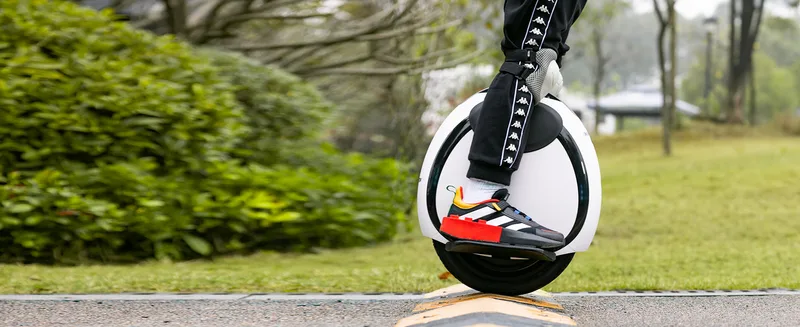
Pressure concentration. Your entire body weight bears down on pedals roughly 25-30 cm (10-12 in) long and 10-13 cm (4-5 in) wide. That’s a tiny platform. The load focuses on the metatarsal heads - the ball of your foot - compressing the nerves running between the bones. Stand on a narrow beam for 30 minutes and you’ll feel the same thing. Now do it for two hours.
Vibration transmission. On non-suspension wheels, 100% of road surface irregularities travel directly into your feet. Every crack, every pebble, every rough patch. Suspension wheels reduce this significantly, but even they transmit high-frequency vibration through the pedals.
Static position. The community calls it “zombie riding” - cruising in a straight line without moving your feet. Your muscles lock in isometric tension, blood flow gets strangled, and numbness sets in. This is the same mechanism that causes pain when standing still at a concert for hours. The human foot isn’t designed for static loading.
Pedal size. Stock pedals on many wheels don’t support the full foot. Your shoe curls around pedal edges, creating pressure ridges that dig into the sole. The smaller the pedal, the worse this gets.
The consequences can be severe if ignored. Forum riders have reported bone growths after a year of daily riding without addressing the problem. Chronic plantar fasciitis after six months of commuting. These aren’t isolated cases - they’re what happens when cumulative tissue inflammation, nerve compression, and muscle fatigue go unaddressed.
The five foot positions
Shane Hilde - a rider who regularly does 150-300 km (93-186 mi) rides on a KingSong 18XL - published the definitive guide to managing foot fatigue on long rides. His five positions are the most referenced technique in the community, and they work. But he emphasizes a prerequisite: roughly 800 km (500 mi) of conditioning before attempting serious distance. Your feet need time to adapt.
1. Arches Up. Rock your foot to lift the arch off the pedal surface. This restores blood flow within seconds. Hilde’s go-to position, used 30-60 km (20-40 mi) into a ride. Simple, effective, doesn’t require advanced balance.
2. Heels Up. Raise the heel to balance on the balls of the feet, stretching the sole. This shifts the pressure zone and relieves the metatarsal area. Intermediate technique - you need decent balance to hold it.
3. Toes Up. Lift toes off the front edge, shifting weight rearward. Relieves constant pressure on the forefoot. Counterintuitive at first because your instinct is to grip with your toes.
4. Hanging Leg. Completely remove one foot from the pedal, letting it hang or rest against the wheel. Advanced technique requiring significant balance skill. Don’t attempt this until you’re comfortable riding one-footed.
5. The Tuck & Roll. An advanced weight redistribution technique involving a full-body shift. Learned from fellow long-distance riders. Requires experience and confidence at speed.
The key insight: you don’t pick one position and stick with it. You cycle through them. Every 10-15 minutes, shift. The movement itself is the medicine - it restores circulation, engages different muscle groups, and prevents any single tissue from bearing load for too long.
Carving - the single best technique
If there’s one thing the entire community agrees on, it’s this: carving fixes foot pain better than anything else.
Carving means riding in S-turns instead of straight lines. The lateral weight shifts engage different muscles, change the pressure distribution across your foot, and promote blood flow. Riders who carve report dramatically less foot fatigue than those who cruise in straight lines at the same speed and distance.
The physics is straightforward. In a straight line, your weight sits on the same contact points for minutes at a time. In a carve, weight shifts from heel-side to toe-side and back every few seconds. No single point stays loaded long enough for numbness to develop.
Build carving into your riding style from the beginning. It’s not just a comfort technique - it’s better riding. You practice balance, improve wheel control, and have more fun. There’s a reason long-distance riders carve instinctively.
Scheduled breaks
Hilde recommends stopping every 30-60 km (20-40 mi) on long rides. Not because the wheel needs it - because your feet do. Get off, walk around, stretch your calves and arches. Five minutes of walking does more for foot recovery than any insole or pedal mod.
The temptation to push through is strong, especially when the riding feels good. Don’t. The pain that hits at 50 km (31 mi) without breaks would have hit at 80 km (50 mi) with them. Breaks aren’t lost time - they’re range extension for your body.
Insoles that work
The right insole transforms the pedal-foot interface from a pressure ridge into a distributed load. Two products dominate the community recommendations.
Superfeet GREEN (~$50-55) is the most frequently recommended insole across EUC forums. High arch support, deep heel cup, semi-rigid construction. It works because it distributes weight across the entire foot instead of letting it concentrate on the metatarsal heads. The rigidity also reduces the “taco effect” - your shoe folding around pedal edges.
Sof Sole gel insoles (~$15-20) are the budget pick. The Sof Sole Athlete model puts gel pads in the heel and forefoot. One experienced rider describes it simply: “It wiped away the sharp pain I eventually had in my foot’s arch and heel.” Less structured than Superfeet but effective for riders who need cushioning more than arch support.
The Sof Sole Airr Orthotic and Boot Insole are alternatives within the same brand, offering different levels of arch support and cushioning.
Custom orthotics are the nuclear option. Urban Soles in Toronto operates what appears to be the only clinic with a dedicated E-Rider Orthotics program for EUC riders. They provide custom prescription orthotics requiring an in-person consultation, biomechanical exam, gait assessment, and foot casting. Comparable custom orthotics run $400-600 per pair, often covered by extended health benefit plans.
For most riders, Superfeet GREEN or Sof Sole gel insoles solve the problem. Custom orthotics are worth exploring if you have pre-existing foot conditions (flat feet, high arches, plantar fasciitis) or ride 50+ km (31+ mi) daily.
The EUC-specific shoe
Kinetic D.L. (Ontario, Canada) produces the only purpose-designed EUC shoe on the market - the Performance-1. It features their Sole Stability Design System (SSDS) with longitudinal rigidity (the sole doesn’t bend around the pedal), thick polyurethane foam removable insole, TPU reinforcement, and anti-pronation design. The Performance-1 is currently sold out, with the Performance-2 high-top forthcoming.
It’s a niche product from a niche company, but it exists because enough riders have the same problem. The EUC footwear guide covers shoe selection in depth.
Pedal modifications
Aftermarket pedals are a substantial upgrade path. Larger pedals distribute pressure over more surface area. Spiked pedals lock your foot in place. Both help - but there’s a critical trade-off.
Larger pedals reduce pressure concentration. The Beidou XL CNC (31.8 x 14 cm / 12.5 x 5.5 in) is one of the largest available. Chicway Honeycomb Off-Road Pedals are described as the longest, widest and heaviest EUC pedal on the market. e-RIDES Honeycomb Spike Pedals (CNC 6061 aluminum, titanium hardware) come with adjustable incline for Sherman, Begode, KingSong, and Inmotion models. FreeMotion CNC Spiked Pedals ($60-100, 304 stainless steel screws) fit the KingSong S22 series.
The spike trade-off. Spiked pedals provide superior grip and control - your foot doesn’t slide, period. But they restrict the subtle foot-shifting movements that are essential for comfort on long rides. The five positions described above require the ability to micro-adjust foot placement without fully lifting your foot. Aggressive spikes make this difficult.
Grip tape - like EUC Clubhouse Spiked Gripads - offers a middle ground. It grips enough to prevent sliding but allows you to shift without lifting. For long-distance comfort, many riders prefer grip tape over spikes.
The practical recommendation: if you ride primarily under 20 km (12 mi) at a time, spiked pedals are fine - the grip benefit outweighs the comfort penalty. If you do long-distance rides, consider grip tape or moderate spikes that allow foot movement. And regardless of spike choice, larger pedals are almost always better than stock.
The conditioning period
Your feet will hurt at first regardless of insoles, pedals, and technique. This is normal. The intrinsic foot muscles, ankle stabilizers, and connective tissue need time to adapt to a load pattern they’ve never experienced.
The community consensus: roughly 800 km (500 mi) of riding before your feet are truly conditioned for distance. That’s not 800 km of suffering - it’s a gradual progression. Ride 5 km (3 mi), then 10 km (6 mi), then 20 km (12 mi). Let recovery happen between rides. Don’t push through sharp pain - that’s tissue damage, not conditioning.
After the conditioning period, most riders report a dramatic improvement. The pain that used to start at 5 km (3 mi) doesn’t appear until 40 km (25 mi). The numbness that was constant becomes occasional. The feet adapt. But only if you give them time.
The complete toolkit - layered approach
No single fix solves foot pain. The riders who do 150+ km (93+ mi) rides use all of these together:
Foundation layer: stiff-soled shoes (Five Ten Freerider Pro or similar - see the footwear guide) with quality insoles (Superfeet GREEN or Sof Sole gel). This addresses the shoe-pedal interface.
Hardware layer: larger aftermarket pedals with moderate grip. This addresses the pedal-foot pressure distribution.
Technique layer: carving as default riding style, cycling through the five positions every 10-15 minutes, scheduled breaks every 30-60 km (20-40 mi), and wiggling toes inside shoes during straight-line sections.
Conditioning layer: gradual distance buildup over 800+ km (500+ mi). No shortcuts.
The first time you ride 60 km (37 mi) without foot pain, you’ll know the system works. It took effort to build it. It’s worth it.
What to read next
Once your feet stop being the limiting factor, the next weak points are usually protection and control. The protective gear guide covers the crash gear worth buying first, and the power pads guide explains when pads start helping with braking, fatigue, and high-speed stability.
555 take
Foot pain is not inevitable - it’s a solvable engineering problem. The rider’s body is part of the system, and it needs the same attention as the wheel’s hardware. Superfeet GREEN insoles, stiff-soled shoes, larger pedals, and carving technique will handle 80% of the problem. The last 20% is conditioning time - your feet adapting to a demand they’ve never faced before.
Don’t ignore foot pain. Don’t ride through it hoping it’ll pass. Address it systematically - insoles, pedals, technique, conditioning - and you’ll ride further than you thought possible. The riders doing 200 km (124 mi) days aren’t genetic freaks. They just solved this problem before you did.