
EUC footwear - what to put on your feet
Your shoes are the interface between you and the pedal. Get this wrong and you get foot pain, poor control, and ankle injuries. Get it right and you ride longer, grip better, and protect yourself when things go sideways.
I’ve ridden roughly 25,000 km (15,534 mi) across two very different shoe setups. The EUC community has strong opinions backed by thousands of collective miles. Here’s what they recommend, what I’ve tested, and what I learned when I made the wrong choice.
What makes a good EUC shoe
Three things matter. Everything else is preference.
Sole stiffness and 1:1 foot transfer. A flexible sole bends around the pedal edge - the community calls this “taco-ing.” But it’s worse than discomfort. A soft, flexible sole doesn’t transfer your foot inputs directly to the pedal. I learned this the hard way when I took my Begode Monster Pro out in mesh Adidas sneakers - sport shoes with a knitted mesh upper. It felt like riding on water. The mesh couldn’t transfer foot pressure 1:1 to the pedal. Every micro-adjustment was delayed, dampened, lost in the material. I was floating, not riding. On a big, heavy wheel where precise control matters, it was genuinely dangerous. Good shoes are the key to being a good rider - and I’m convinced of this because the difference between proper footwear and sneakers was night and day on the same wheel.
Grip. Your foot must not slide on the pedal. A slip during acceleration or braking at 40 km/h (25 mph) is how people get hurt. Flat, high-friction rubber outsoles designed for flat pedal mountain biking give the best grip on EUC pedals. But flat soles also matter for another reason: spiked pedal pins need something to bite into. A treaded hiking sole or curved running sole doesn’t give pins consistent purchase.
Ankle support. Your ankles work constantly on an EUC - micro-adjustments for lateral balance, absorbing bumps, controlling lean. Beginners bash their ankles against the wheel shell constantly. Mid-top or high-top shoes protect the ankle bone and provide structural support for the joint.
My 25,000 km in motorcycle boots
I spent roughly 25,000 km (15,534 mi) in Shima Rebel WP 2.0 motorcycle boots. These are low-rise motorcycle sneakers with suede uppers treated with DWR coating, a waterproof NextDry membrane, and certified ankle protectors. They have reinforced toes, heels, and ankles, plus a transverse-reinforced anti-slip rubber outsole and an internal polypropylene stiffening insole.
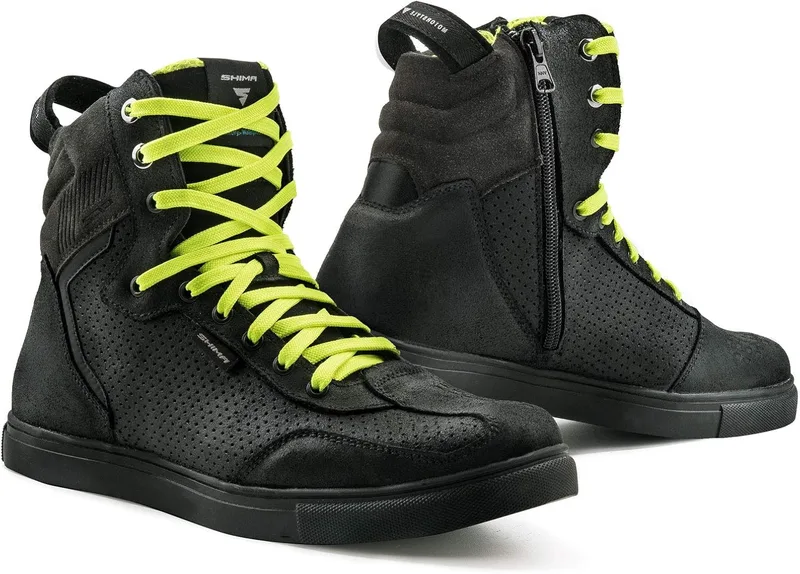
Here’s what 25,000 km taught me about them:
The flat sole was critical. The Rebel’s outsole is flat and firm - pedal pins bit in cleanly and held. No taco-ing, no flex. Foot inputs went straight to the pedal, 1:1. Combined with a replacement insole (the stock one is adequate, aftermarket is better), I had zero foot pain during full-day rides. All-day comfort, no arch issues, no numbness.
Ankle protection worked. The boots wrap the foot securely with good structural support. The certified ankle protectors provided real protection during crashes - and at EUC speeds, ankle protection isn’t optional. The boot absorbed shell contact during normal riding without discomfort.
Waterproofing held. The NextDry membrane kept feet dry through rain and wet roads. Combined with a thermal overshoe (the cycling SPD type) in winter, they handled 2°C (36°F) all-day rides without issues.
They survived crashes. At 70+ km/h (43+ mph), crashes produced only light scuffing on the boots - no visible damage to speak of. The reinforced structure held. Feet were completely protected.
One critical flaw: the inner zipper. The Rebel has a side zipper on the inner ankle for easy on/off. That zipper sits exactly where the EUC shell contacts your leg. With constant leg flexion during riding - bending, gripping, adjusting - the zipper wore out badly. It started opening on its own during rides. This is the one design element that doesn’t work for EUC. A motorcycle doesn’t flex your ankle the way an EUC does, so the zipper was never designed for this use pattern.
Verdict on the Rebel: excellent EUC boot except for the zipper issue. If Shima made a version without the inner zipper - or with a more robust closure - it would be close to perfect.
What I ride now
After the Rebel’s zipper finally gave up, I switched to Quechua MH100 waterproof trekking boots from Decathlon - mid-height hiking shoes with a rubber outsole, rubber toe cap, waterproof breathable membrane, EVA foam midsole, and hook-locking lace system.
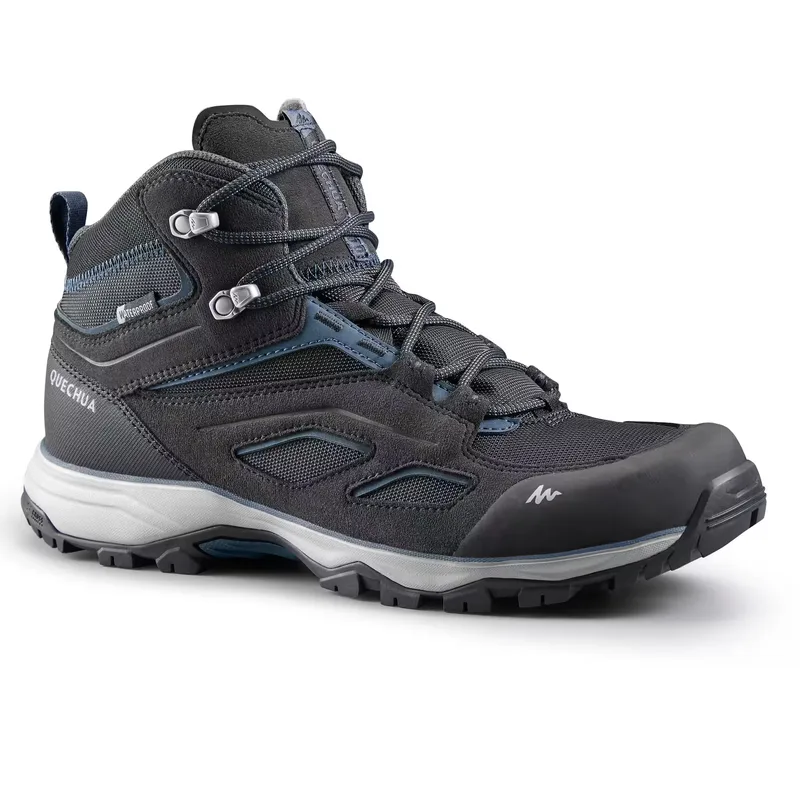
The transition required adjustment. Here’s the honest comparison:
Foot comfort is lower than the Rebel. The Rebel wrapped the foot more securely and the internal structure provided better support. The Quechua is a hiking shoe - designed for forward motion on uneven terrain, not standing on a 13 cm (5 in) wide pedal for hours. Foot pain appears sooner and the overall comfort level is lower. Replacement insoles help, but the Rebel was simply better for standing.
The lacing system is good. Quick on/off, secure fit. The hook-locking system holds well during riding.
After switching to pedals with taller pins, grip improved noticeably. The pins bite into the Quechua outsole tread more effectively, so the foot sits more securely on the pedal.
They’re cheap and replaceable. This is the practical argument. EUC riding destroys shoes - pedal pins, shell contact, crash abrasion. The Quechua costs a fraction of the Rebel. When they’re worn out, I replace them without agonizing over the price. For riders who go through shoes quickly, disposable price is a real factor.
The mesh sneaker disaster
I mentioned this above but it deserves emphasis because it’s the most important footwear lesson I’ve learned.
I went out on my Begode Monster Pro - a 24-inch, 40+ kg (88+ lbs) GT wheel - wearing mesh Adidas sport sneakers. The kind with a knitted mesh upper designed for running.
It was like swimming. The mesh didn’t transfer foot pressure to the pedal at all. Every input was delayed, absorbed, lost. On a massive wheel that requires precise, confident inputs for speed control and balance, I was completely disconnected from the machine. Not uncomfortable - dangerous.
Good shoes are the key to being a good rider. I didn’t fully understand this until I experienced the opposite. A stiff, flat sole with direct foot-to-pedal transfer is not a luxury - it’s a control requirement.
The Five Ten consensus
The Five Ten Freerider Pro (~$100-130) is the overwhelming community pick. Ask in any EUC forum, subreddit, or YouTube comment section and this shoe dominates. Its Stealth S1 Dotty rubber outsole - developed for flat pedal mountain biking - provides legendary grip on metal pins. The sole is stiffer than a skate shoe but not rigid like a boot: enough to prevent taco-ing while keeping pedal feel.
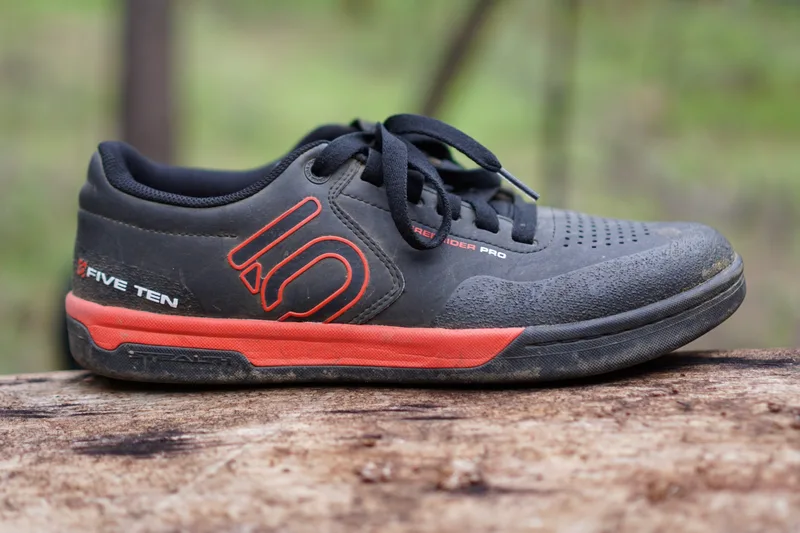
The Five Ten lineup extends beyond the base Freerider Pro:
Freerider Pro Mid VCS (~$180) adds D3O ankle protection and Velcro straps. Best Five Ten for beginners who need shell-rub protection.
Impact Pro (~$150-170) - maximum downhill-grade protection. Thickest sole, most ankle padding. Worth considering for off-road riding.
Trailcross Gore-Tex (~$160-180) adds waterproofing. But read the waterproofing section below before buying Gore-Tex shoes.
Sleuth (~$75-90) - lightweight urban option. Less protection, less stiffness. Acceptable for casual commuting under 15 km (9 mi).
Standard Freerider (~$80-100) - budget entry. Same Stealth rubber, less stiff sole than the Pro.
I haven’t personally tested Five Tens long-term. The community consensus is strong enough that I trust it - the Stealth rubber’s grip reputation is earned across mountain biking and EUC alike.
Other community favorites
Vans MTE / MTE-2 (~$100-150) are popular for their flat hard sole, good cushioning, and street style. EUC YouTuber Mickey Miklos rides them prominently. Less grip than Five Ten’s Stealth rubber on spiked pedals but work well on grip tape. Good for riders who want a shoe that looks normal off the wheel.
Ride Concepts Vice (~$100-120) - the Five Ten alternative from MTB. Similar flat pedal philosophy, different fit.
Shimano GR7 / GR9 (~$80-120) - cycling shoe quality applied to flat pedal riding. GR9 has excellent grip and stiffer platform. Japanese fit tends to run narrow.
Specialized 2FO Roost (~$100-130) - MTB flat pedal shoe with competitive grip. Good ventilation.
What doesn’t work
Mesh sneakers / running shoes. I’ve explained why above. The mesh doesn’t transfer foot inputs. The curved sole rocks on the pedal. Zero ankle or abrasion protection. Running shoes are designed for forward motion on flat ground - not standing on a narrow platform absorbing vibration. Don’t ride in them.
Traditional stiff motorcycle boots. The community describes them as “almost universally disliked” for EUC. The problem isn’t the sole - it’s the ankle. EUC riding requires constant ankle micro-movements for balance and steering. A rigid motorcycle boot locks that movement out. You lose control sensitivity and tire faster fighting the boot.
The exception - and my personal experience confirms this - is modern lightweight motorcycle riding shoes like the Shima Rebel. These maintain ankle mobility while adding impact protection. The key difference: riding shoes flex at the ankle, traditional boots don’t.
Hiking boots serve commuters reasonably well if they have a flat-ish sole where pins can grip. But most lack the sole stiffness and flat-pedal grip of MTB shoes or motorcycle riding shoes. My Quechua works, but I notice the lower comfort compared to the Rebel. Hiking boots are a compromise.
High-top vs low-top
The community leans toward mid-top or high-top for most riding. My experience supports this:
High-tops protect ankles from shell rubbing. During normal riding, your ankle bone contacts the EUC shell repeatedly. Without coverage, you get bruises and abrasion. Both my Rebel and Quechua - both mid-height - eliminated this entirely.
High-tops protect during bail-outs. Stepping off at speed can twist your ankle. Structural support matters more at higher speeds and on uneven terrain.
High-tops protect from debris. Off-road riding kicks up rocks, sticks, and dirt.
Low-tops are acceptable for summer commuting with ankle guards. They offer better ventilation and more freedom. But for most riding - especially learning, off-road, and cold weather - mid or high-top is the right call.
The waterproofing question
My Rebel had waterproof membrane and it worked well. But experienced riders have increasingly moved toward waterproof socks (SealSkinz, ~$30-50) instead of waterproof shoes. The reasoning:
Gore-Tex degrades with heavy use. And once water gets inside a waterproof shoe - from rain running down your leg, from a deep puddle overtopping the shoe - it’s trapped. The membrane that keeps water out also keeps water in. Your foot sits in a warm puddle for the rest of the ride.
Waterproof socks keep your foot dry regardless of shoe state. Wet non-waterproof shoes drain and dry faster than wet waterproof shoes that got water inside. After a rainy ride, regular shoes dry overnight. Gore-Tex shoes with trapped water can take days.
My approach now: the Quechua has a waterproof membrane that handles light rain. For heavy rain, I add cycling shoe covers (the SPD overshoe type). In winter at ~2°C (36°F), the overshoe provides thermal insulation too. This combination has handled all-day rides in every weather condition I’ve encountered.
The purpose-built EUC shoe
Kinetic D.L. (Ontario, Canada) makes the only shoe designed specifically for EUC - the Performance-1. Its Sole Stability Design System (SSDS) provides longitudinal rigidity that prevents sole flex, thick polyurethane foam insole, TPU reinforcement, and anti-pronation design. The Performance-1 is currently sold out, with the Performance-2 high-top forthcoming.
A niche product that validates the market - enough riders care about this problem that a dedicated product exists.
The insole factor
Both shoes I’ve ridden long-term had replacement insoles. This single change eliminates most foot pain issues for most riders. The stock insole in any shoe is a cost-cut compromise. A quality aftermarket insole - Superfeet GREEN ($50-55) for arch support or Sof Sole gel ($15-20) for cushioning - transforms the pedal-foot interface.
The foot pain guide covers insoles in depth. But the short version: whatever shoe you pick, replace the insole. It’s the highest-impact comfort upgrade per dollar in all of EUC gear.
How to choose
If you want the community consensus: Five Ten Freerider Pro (~$100-130). Stealth rubber grip, proven stiff sole, thousands of riders. Add Superfeet GREEN insoles.
If you want motorcycle-grade protection: A modern riding shoe like the Shima Rebel WP 2.0 (~$120-160) or similar (TCX, Alpinestars sneaker-style). Flat sole, ankle protection, waterproof membrane. Check for inner zipper placement - avoid designs where the zipper sits on the shell contact zone.
If you want cheap and replaceable: Quechua MH100 or similar trekking mid-boots (~$50-80) with spiked pedals and replacement insoles. Less comfortable than dedicated options, but practical when you go through shoes quickly.
If you want urban style: Vans MTE-2 (~$100-150). Looks normal, performs adequately.
For beginners: Five Ten Freerider Pro Mid VCS (~$180) with D3O ankle protection. Or any mid-height shoe with a flat, stiff sole. Your ankles will thank you during the first month of shell-bashing.
Whatever you choose: flat sole, stiff platform, high grip, at least mid-height. If the shoe has these four things, it’ll work on an EUC.
What to read next
If you already have decent shoes but your feet still hurt, the problem usually moves from footwear to pressure management. The foot pain guide covers insoles, pedal size, carving, and the long-distance foot positions that matter once rides get longer.
Shoes also sit inside a larger safety setup. If you are building your first kit, pair this guide with the protective gear guide before spending money on accessories that do not protect you in a fall.
555 take
Good shoes are the key to being a good rider. Not good balance, not good reflexes - good shoes. The foot-to-pedal connection is the foundation of everything: control, comfort, safety, confidence.
I’ve tested this across 25,000 km (15,534 mi) in motorcycle boots, trekking shoes, and one terrible ride in mesh sneakers. The difference between proper footwear and wrong footwear isn’t subtle - it’s the difference between riding and swimming.
The Five Ten Freerider Pro is the right pick for most riders. Motorcycle riding shoes (not boots - riding shoes) are underrated by the community but excellent in practice. Trekking boots work as a budget option. Mesh sneakers will get you hurt.
Spend $80-160 on proper shoes. Add $15-50 for insoles. That investment does more for your riding than any other gear purchase at the same price point. Your feet are on the pedals for every kilometer. Make them count.