
EUC battery fires - the real risk
Lithium-ion battery fires in personal electric vehicles are a global safety crisis. New York City alone has documented over 900 fires, 500+ injuries, and 33 deaths since 2019. The UK recorded 432 e-bike fires in 2025 - a fivefold increase from 2021. China reported 21,000 e-bike fires in a single year. Headlines scream danger.
But here’s the part that matters for EUC riders: almost none of those fires involved electric unicycles. The crisis is overwhelmingly an e-bike problem - specifically cheap replacement batteries without proper management systems. When the UK tracked 211 micromobility fires in 2024, exactly one was an EUC. One.
That doesn’t mean EUC riders can ignore the risk. It means they need context.
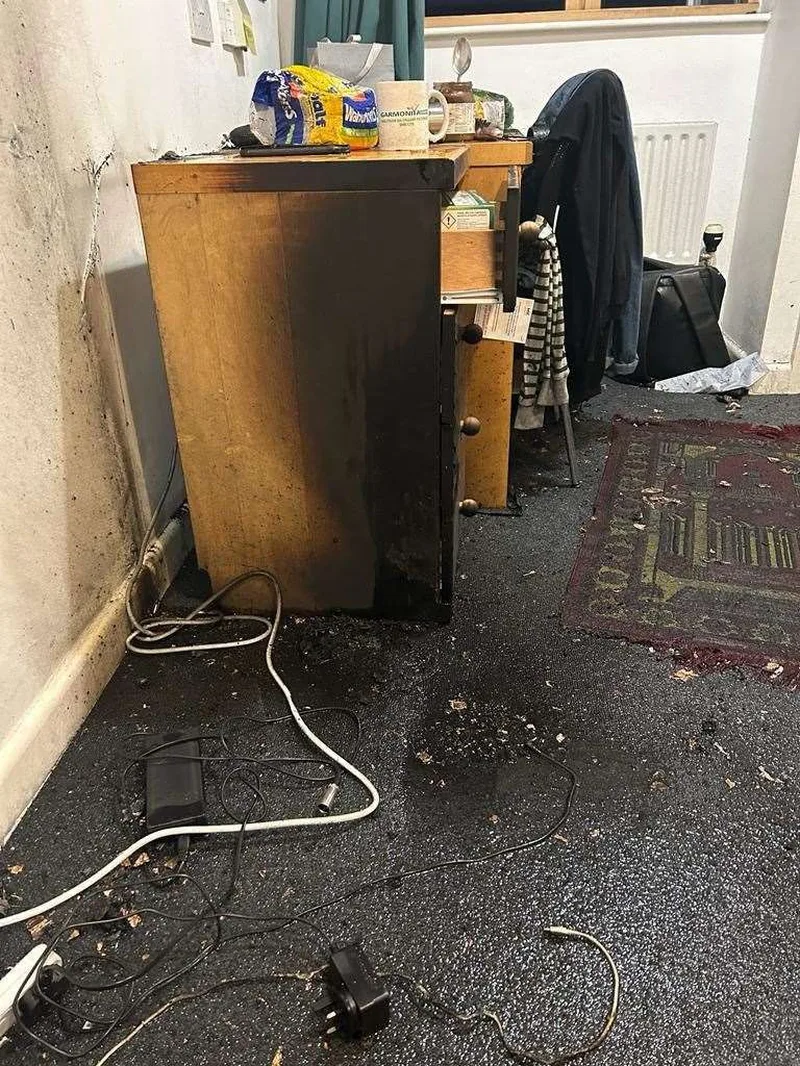
The numbers
The EUC community maintains a meticulous fire database - a thread on forum.electricunicycle.org with over 780 replies and nearly 99,000 views, cataloging every known EUC fire worldwide. As of late 2022, the count stood at 58 confirmed fires across a global fleet estimated at over 100,000 wheels.
That’s a fire probability of less than 1 in 1,000 - across all brands, all years, all cell types. Modern wheels with Samsung cells and SmartBMS are almost certainly far lower, but the fleet is too young for reliable long-term statistics.
Compare that to e-bikes: New York City recorded 277 lithium-ion battery fires in 2024 alone, against an estimated 65,000 delivery e-bikes. The FDNY calls the worst offenders “Frankenstein batteries” - cheap packs cobbled together without UL certification or proper BMS. A single warehouse fire in Gdansk, Poland in February 2025 destroyed approximately 1,300 e-bikes and 1,000 batteries in one event.
EUC fires are rare. E-bike fires are an epidemic. The distinction matters because regulation often lumps all micromobility devices together - and EUC riders pay the price for problems they didn’t create.
Which brands have burned - and what actually happened
Begode (formerly Gotway) carries the fire reputation. Partly earned, partly unfair.
In December 2022, the U.S. Consumer Product Safety Commission issued an official recall of approximately 500 Begode MSP, Nikola+, and RS unicycles sold through eWheels. The reason: 14 fire incidents including property damage and one injury. The root cause was a specific batch of defective 21700 LG battery packs prone to spontaneous combustion. eWheels provided free replacement LiTech battery packs at its own expense. Begode offered no support for the recall.
That recall cemented Begode’s reputation. But the context matters: the problem was specific cells from a specific supplier in a specific generation of wheels. Since Begode transitioned to Samsung cells and the Master line, fire incidents from Begode wheels have essentially disappeared. Three-plus years of the Master, Master Pro, EX30, and Blitz on Samsung 50S and 50GB cells - and the fire thread on the forum is quiet. Begode fixed the problem. That deserves to be said clearly.
Meanwhile, brands with “cleaner” reputations have had their own incidents. The Inmotion V11 - one of the most popular suspended wheels ever made - has multiple documented fire and thermal events in the community fire thread. KingSong models have appeared in fire reports too. The LeaperKim Veteran Sherman - a wheel beloved by the long-range community - has had confirmed fire incidents. No brand is immune. The difference is that Begode got a formal CPSC recall, which created a public record. Other brands’ incidents stayed in forum threads and private conversations.
LeaperKim itself has an origin story worth knowing. The company was founded by former Begode engineers who left knowing exactly what went wrong - the design shortcuts, the cell sourcing decisions, the BMS limitations. They built Veteran wheels from scratch with those lessons embedded: SmartBMS with per-cell monitoring, controller-side fallback on hall sensor failure, thermal management designed from the start. Without Begode’s failures, LeaperKim as it exists today probably wouldn’t exist. The failures drove the innovation.
Pack configuration correlates with risk across all brands. 4-parallel (4P) configurations appear in most fire incidents. 6P and 8P configurations - where each cell handles less current - have far fewer reported problems. This aligns with the physics: fewer parallel groups means each cell works harder, runs hotter, and has less margin for manufacturing defects.
The 555 position: every major EUC brand has had fire incidents. Begode’s 2021-2022 era was the worst, and the CPSC recall made it public. But freezing Begode’s reputation in 2022 while ignoring V11 fires and Sherman fires is dishonest. The current Begode lineup on Samsung cells has a clean record. Judge the wheel you’re buying, not the wheel from four years ago.
How thermal runaway works
Understanding thermal runaway changes how you think about battery safety. It’s not a gentle failure - it’s a violent, self-sustaining chemical reaction.
A lithium-ion cell operates safely within a temperature window. Push past roughly 150-210°C (302-410°F) for NMC chemistry (what most EUCs use), and the cell enters thermal runaway. The separator between anode and cathode melts. Internal short circuits form. Exothermic reactions begin - the cell generates its own heat, independent of any external source.
Once thermal runaway starts in one cell, it heats adjacent cells. They enter thermal runaway. The cascade propagates through the pack.
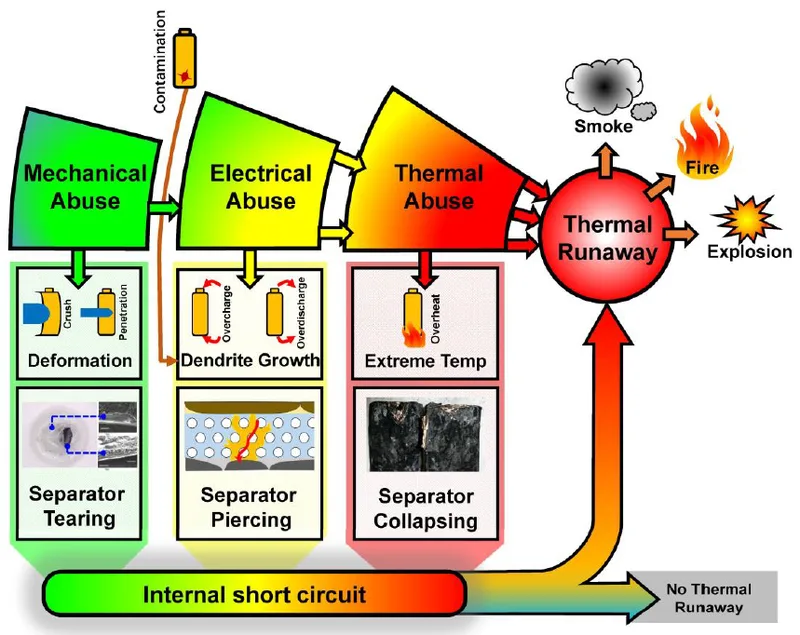
The physics are terrifying:
- Temperatures reach 600-1,000°C (1,112-1,832°F)
- Flames can reach 3-5 meters (10-16 ft) in height
- Toxic gases include hydrogen fluoride and carbon monoxide
- Approximately 25% of suppressed fires reignite within 24 hours
- A single cell can go from first sign of trouble to full thermal runaway in seconds
Hospital data from Singapore - which tracks PMD fire burn victims systematically - found a 10% mortality rate among those admitted. 73% suffered inhalation injuries from toxic gases. 43% of patients were children.
Water doesn’t extinguish lithium-ion fires effectively. The reaction generates its own oxygen. Fire suppression buys time for evacuation - it doesn’t reliably stop the process.
Root causes
EUC and micromobility battery fires follow a consistent pattern of causes:
BMS failure. The Battery Management System is supposed to detect faults and shut down before damage cascades. When the BMS fails - through manufacturing defect, design inadequacy, or component degradation - a single cell fault can propagate unchecked through the entire pack. This is why smart BMS with per-cell monitoring matters: it catches problems earlier.
Physical damage. A drop or crash can create invisible internal short circuits. The cell looks fine externally. Inside, a separator is deformed or a connection is compromised. The short may not manifest immediately - it can develop over days or weeks as microscopic damage worsens through thermal cycling and vibration.
Water ingress. Water inside a battery pack causes corrosion on connections and cell terminals. Corrosion creates resistance. Resistance creates heat. Heat accelerates corrosion. This is a slow-motion failure that can trigger thermal events weeks or months after the water exposure. Riding through a deep puddle on Tuesday can cause a fire on Saturday.
Overcharging. Using an incompatible charger that pushes cells above 4.2V causes lithium plating on the anode - metallic deposits that create internal short circuits. CPSC data attributes roughly 35% of all lithium-ion battery fire incidents to overcharging with wrong equipment.
The critical detail: about 60% of NYC fires in 2023 occurred when batteries were not charging. They were sitting idle or in use. This destroys the comforting assumption that fire risk exists only during charging. Damaged cells can fail at any time.
Warning signs
Your battery gives warnings before catastrophic failure. Recognize them:
Excessive heat during normal charging or use. If the battery area is noticeably hot to the touch during routine operation - not after a hard ride, during normal use - something is wrong.
Swelling or bulging of the battery case. This means cells are generating gas internally - a sign of active chemical degradation. A swollen pack is a pack preparing to fail.
Sweet or chemical odors coming from the wheel. Electrolyte leakage has a distinctive sweet, solvent-like smell. If your EUC smells wrong, stop using it.
Hissing or cracking sounds from the battery area. Gas is venting from cells under internal pressure.
Dramatic range reduction. If your range drops suddenly - not gradually over months, but noticeably over days or weeks - a cell or cell group may be failing. Check SmartBMS data if available.
Sudden voltage drops during rides. If your voltage reading jumps erratically under load, cell connections or cells themselves may be compromised.
Any of these symptoms means: stop using the battery immediately. Do not attempt to charge it. Do not store it inside your home. Arrange safe disposal.
The CPSC has documented cases where batteries ignited while not charging, not in use, and simply sitting in storage. A damaged battery is dangerous at rest.
How to reduce your risk
The fire probability for EUCs is already extremely low - less than 1 in 1,000 overall, and modern wheels with Samsung cells and SmartBMS have pushed that number lower still. These practices keep it there:
Buy wheels with smart BMS and quality cells. SmartBMS with per-cell monitoring is now standard on LeaperKim, Inmotion, KingSong Pro, and current new Begode models. Samsung 50S, 50GB, and equivalent high-quality cells are the industry baseline. If the wheel you’re considering has both - you’re starting in good shape regardless of brand.
Buy from trusted distributors. A good seller can check batches, verify battery packs before shipping, and actually help when the manufacturer fails. During the Begode recall, responsible distributors stood behind their customers - that kind of accountability matters.
Check SmartBMS monthly. Look for cell voltage deviation. All cells in a healthy pack should be within 0.05V of each other. A cell consistently 0.1V or more below its neighbors is failing. Catch it early.
Don’t ride hard on a damaged wheel. If you’ve had a serious crash, inspect the battery. Better yet, have a specialist inspect it. Internal damage from impact may not be visible from outside.
Avoid deep water. IP ratings on EUCs are optimistic at best. Water ingress to the battery pack creates delayed fire risk. If your wheel went through deep water, open the shell and dry everything - or have someone experienced do it.
Follow charging best practices. The charging-safety article covers this in detail - location, temperature, charger selection, charge levels, and detection equipment.
555 take
EUC battery fires are rare - dramatically rarer than the e-bike fire epidemic dominating headlines. But “rare” is not “impossible,” and thermal runaway is catastrophic when it happens.
The brand picture is more nuanced than the internet makes it. Begode earned its fire reputation in 2021-2022 with specific LG cells in specific models - and then fixed the problem. Inmotion V11, KingSong models, and LeaperKim Sherman have all had documented fire incidents too, without the same level of public scrutiny. Every major brand has scars. What matters in 2026 is what’s in the wheel you’re buying today: the cell model, the BMS quality, the pack configuration, and the manufacturer’s track record on the current generation.
The practical response is not fear - it’s informed choices and basic discipline. Buy a wheel with SmartBMS and quality Samsung cells. Check your cell voltages regularly. Don’t charge a damaged battery. Don’t store a wheel you suspect is compromised inside your living space.
The euc-batteries article covers what’s inside your pack - chemistry, BMS, voltage sag. This article covers what happens when that pack fails. Both matter. Understanding both means you ride with knowledge instead of anxiety.